A game about the security dilemma, balancing and bandwagoning, and guns against butter, made for a classroom and played first by the people named below.
“The Assyrian came down like the wolf on the fold” Lord Byron · The Destruction of Sennacherib · 1815
Our beta testers
Every bug you met, every alliance you broke, and every strike you launched made this a better game. Thank you.
How it began
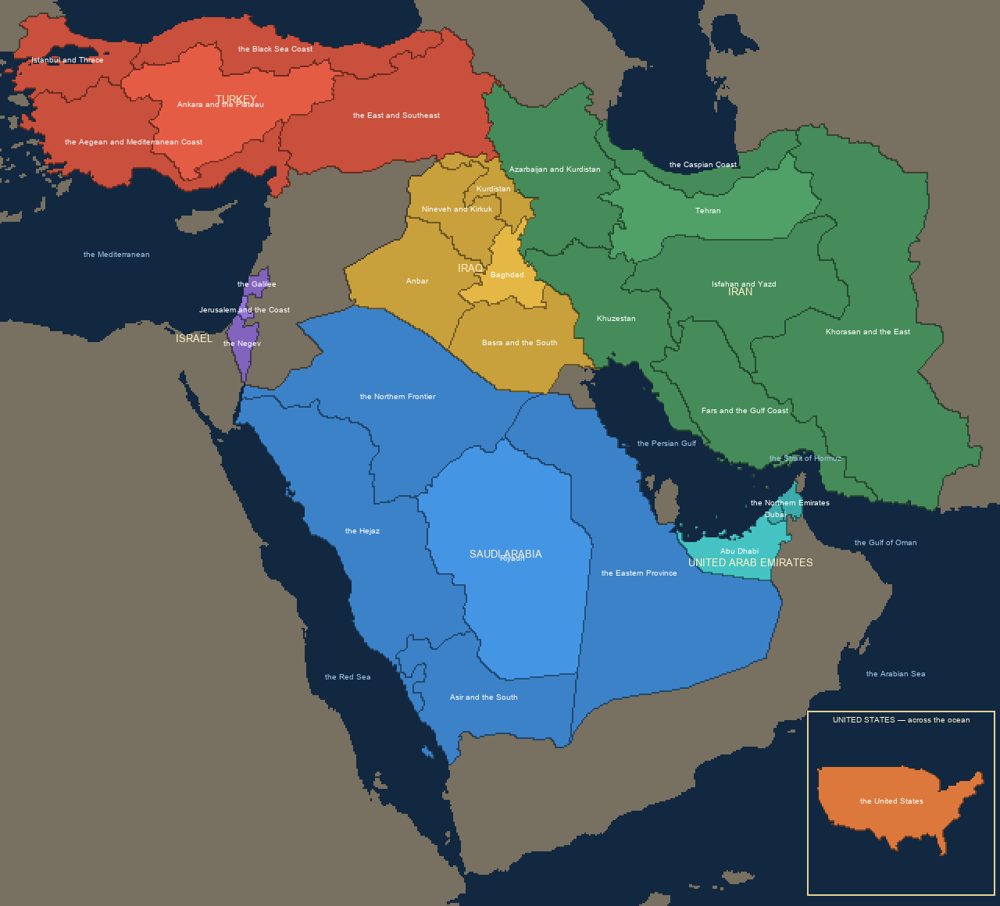
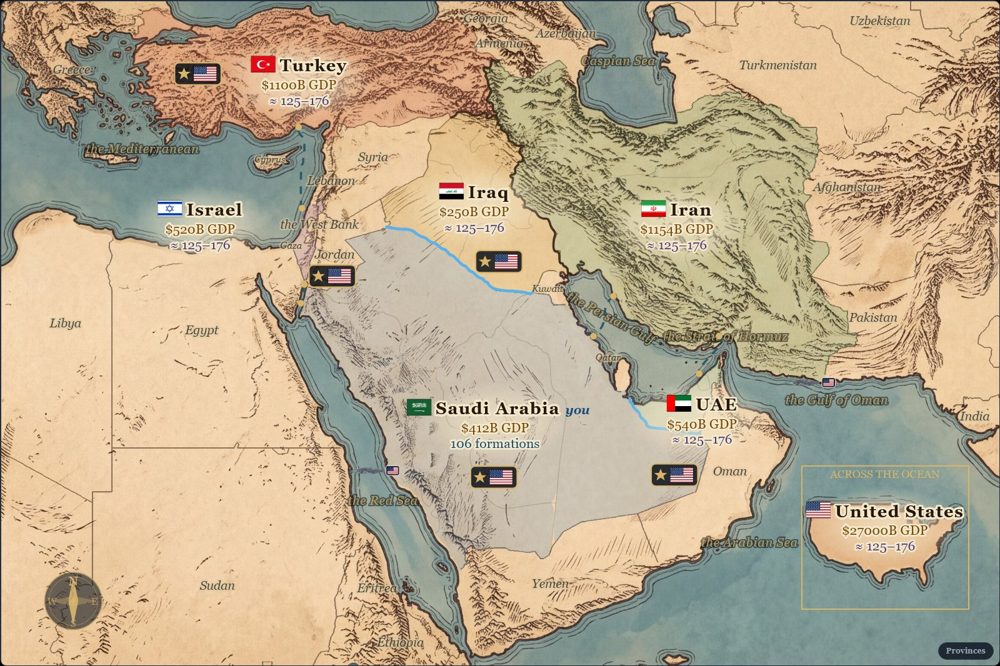
Under the hood
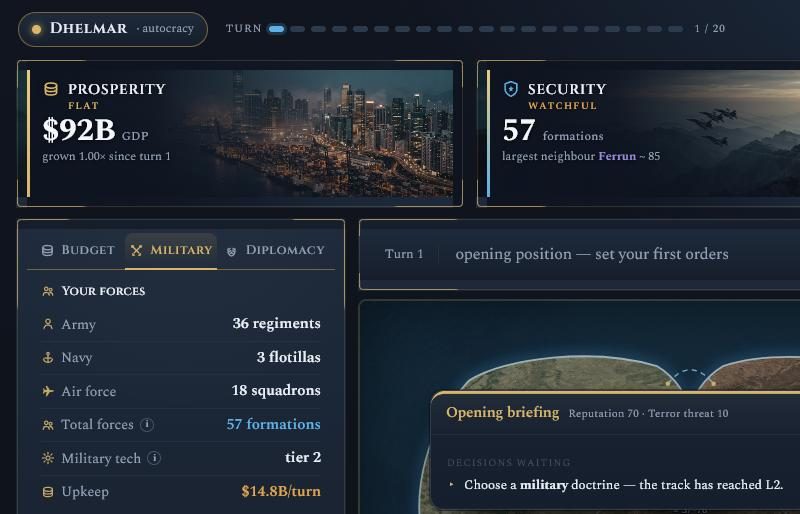
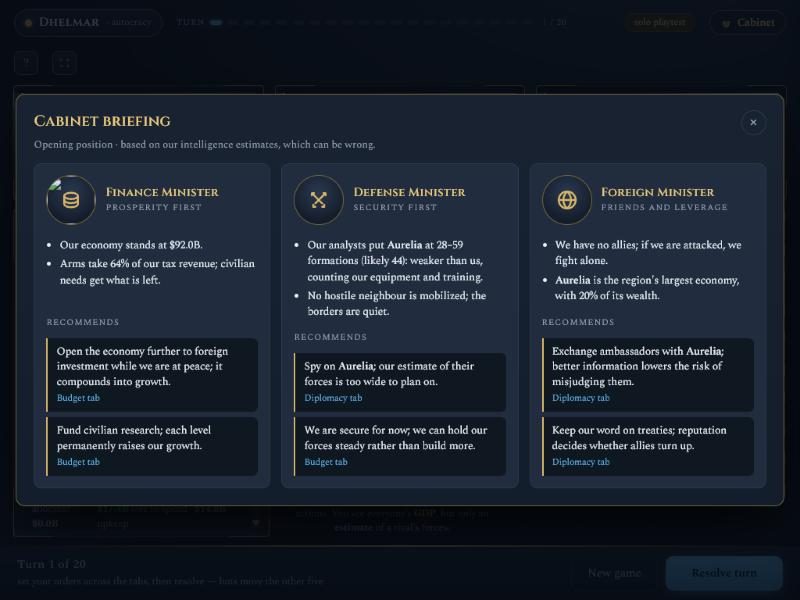
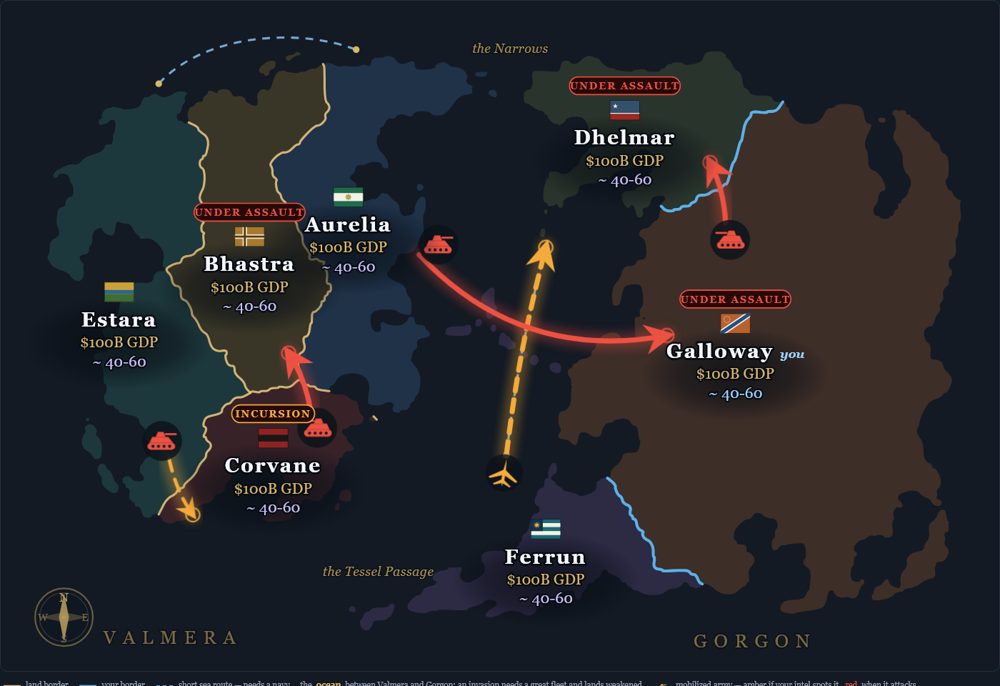
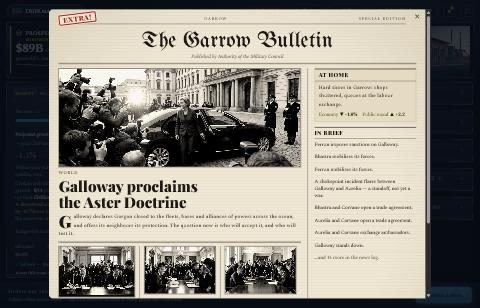
Before anyone played a turn, the computer played this game against itself, hundreds of games at a time, every time a rule changed. Here are some pages from those notebooks.
The security dilemma, measured
The same 200 worlds, played twice: once where every country can see the others' true strength, once in the fog of estimates you played in. In the fog, everyone spent about 15% more on arms in the first 10 turns, from uncertainty alone, and the world ended up poorer. Nobody behaved foolishly. That is the security dilemma.
$ python run_playtest.py 200
…
6. SECURITY DILEMMA TEST  (the one that matters)

                             noise on   noise off      change
   mil spend, turns 1-10       1253.2      1085.9      15.4%
   world economy               1137.9      1193.7      -4.7%
   wars per game                 9.89        7.25      +2.64

   -> WORKING. Uncertainty alone drives states to arm more heavily,
      leaving the world poorer without making anyone safer.
      That is the security dilemma, and students will feel it.
Held through every rebuild
Every time the rules were rebuilt, the same test ran again. If the fog ever stopped making countries arm, the game would no longer be teaching what it was made to teach.
In the very first version, the peaceful trader won 61% of games and the hawk won 1.8%. Being defenceless was perfectly safe: defenders had the advantage, allies came to help, and every attack was a losing bet.
That would have taught “never arm”, the exact opposite of the lesson, and there is no security dilemma if arming never pays. Tuning four rules (what a conquest wins, how much allies help, how much security counts, what aggression costs your reputation) closed a gap of 59 points to about 15.
Balance failures are invisible in a design document and obvious within twenty minutes of automated play.
For most of the game's life, a non-aggression pact really stopped an attack between the two countries that signed it.
But the security dilemma rests on one idea: you cannot trust a promise you cannot enforce. A pact that mechanically stopped a war let a signature buy real safety, which is exactly what a signature cannot buy. The historical case is Molotov–Ribbentrop in 1939, then Barbarossa in 1941: the paper was worthless the moment the balance of power shifted.
So it went. Your safety rests on what really holds it up: strength, allies, and deterrence.
The computer players were spending 25 to 35% of their economy on the military, in peace as in war. The yardsticks: the world today, about 2%. Great powers in 1913, 3–5%. The Cold War United States, 5–10%. The Soviet Union, 12–17%. Germany in 1938, 17–25%. Total war, 37–60%.
“I want diplomacy and strategy to matter, not just pouring crazy amounts of money into the military,” the designer wrote. So security became enough, not most: you score for being able to defend yourself, not for outspending the world. The computer's arms spending fell to about 11%.
What the tests found
From the cutting-room floor
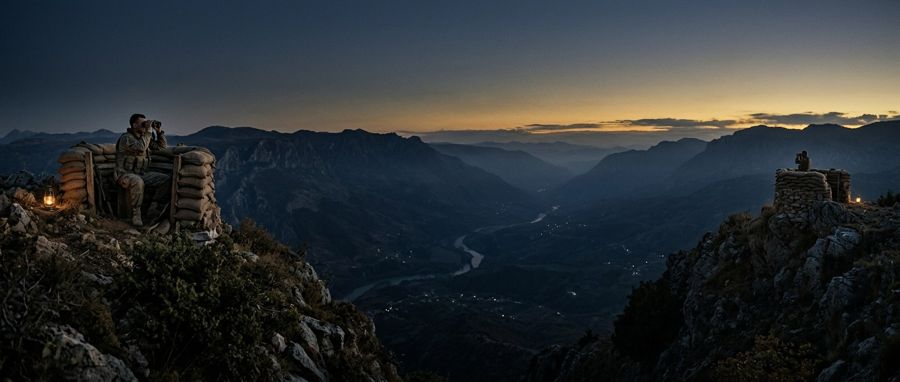
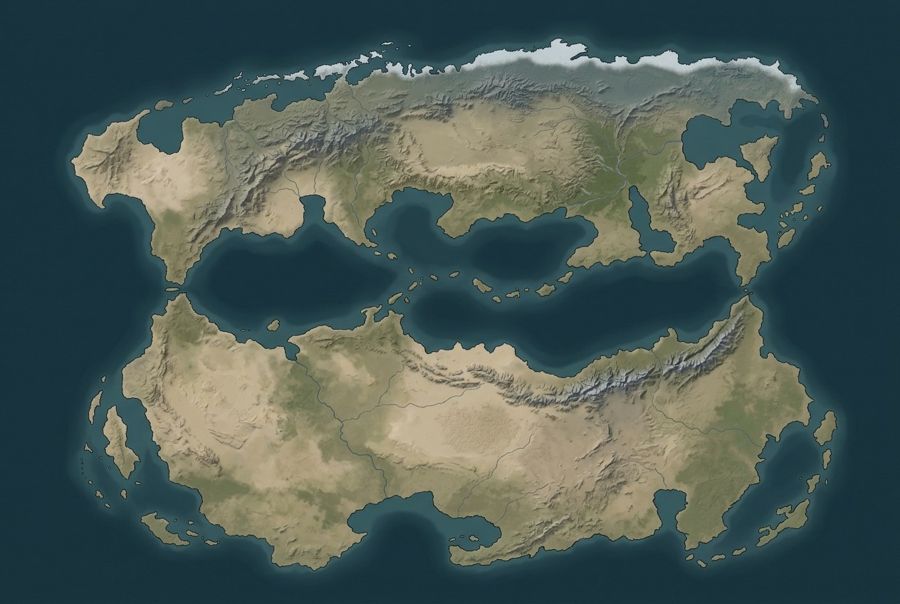
A few pictures we made and didn't use.
Recommended reading
The ideas this game is built on, and where you can see them in play.
- Stephen M. Walt · The Origins of Alliances (1987) States balance against threat, not just power. The game is named for it.
- Robert Jervis · Perception and Misperception in International Politics (1976) Why you only ever see an estimate of your rivals, and why the estimate can be wrong.
- Robert Jervis · “Cooperation under the Security Dilemma” (1978) Arming for defence frightens your neighbours, who arm in turn.
- Kenneth N. Waltz · Theory of International Politics (1979) No world government, so every state looks after itself.
- John J. Mearsheimer · The Tragedy of Great Power Politics (2001) Regional hegemons, and powers across the ocean who balance from offshore.
- Thomas C. Schelling · Arms and Influence (1966) Ultimatums, threats, and why a threat is only as good as your will to carry it out.
- James D. Fearon · “Rationalist Explanations for War” (1995) Why wars happen even when both sides would be better off with a deal.
- Robert Axelrod · The Evolution of Cooperation (1984) Why you were never told how many turns the game would last.
- Robert Gilpin · War and Change in World Politics (1981) Rising and declining powers, and the wars between them.
- Charles P. Kindleberger · The World in Depression, 1929–1939 (1973) An open world economy needs someone to hold it up: the sea lanes.
- Erik Gartzke · “The Capitalist Peace” (2007) Open economies, nervous investors, and the price of war in foreign capital.
- Mancur Olson · The Logic of Collective Action (1965) Why everyone wants the counterterror fund paid, and no one wants to pay it.
- Robert D. Putnam · “Diplomacy and Domestic Politics: The Logic of Two-Level Games” (1988) Every decision is played at home as well as abroad.
- Robert A. Pape · Bombing to Win (1996) Why bombing a country's cities so rarely makes it give in.
- Peter P. Perla · The Art of Wargaming (1990) How professional wargames are built and played: the Gulf crisis follows its lead.
- Thucydides · History of the Peloponnesian War Where all of this starts: fear, honour and interest.